The Bin That Never Got Worn
Last spring, I pulled out the storage bin of warm-weather clothes for Ella and found a pair of floral shorts I'd bought on clearance the previous August. Tags still on. They were cute, they were cheap, and they matched nothing in her drawer. That pair of shorts — and six other impulse seasonal buys — went straight into the donate pile. I added up what I'd spent on those unworn pieces: $78. That was a full season's budget wasted on things she never even tried on.
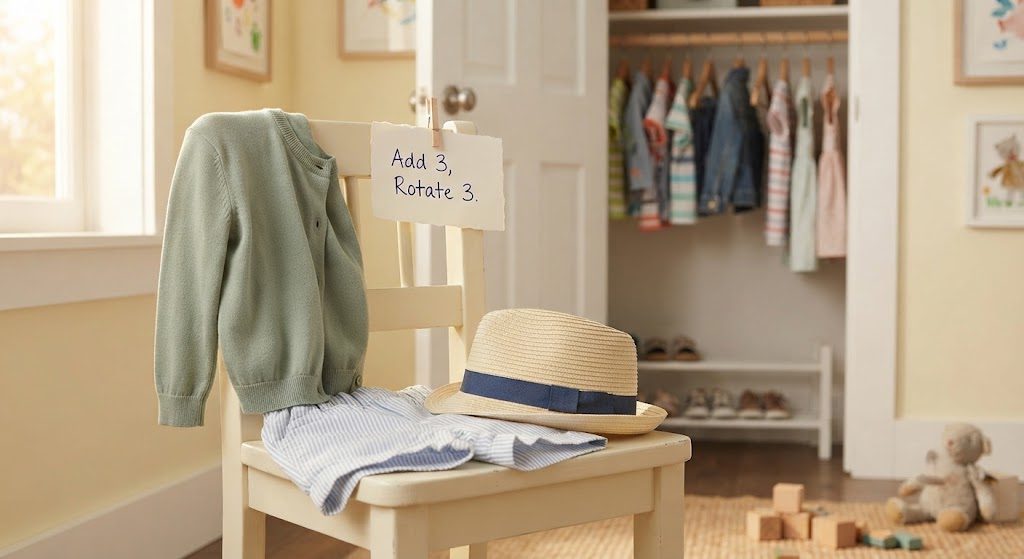
After that, I created a rule that has guided every seasonal refresh since: add three pieces, rotate three out. Not a complete overhaul, not a shopping spree triggered by the first warm weekend. Three intentional additions that earn their place by filling real gaps. Here's how I find them.
Start With the Rotate-Out Pile
Before I buy anything new, I go through the current wardrobe and pull three items that no longer serve us. This does two things: it clears physical and visual space, and it forces me to articulate why each piece is leaving. The reasons usually fall into three categories.
Outgrown or Worn Out
The most straightforward category. Jeans with knees worn thin, a tee that's suddenly a crop top, elastic that gave up. If Maya can't wear it comfortably or it won't survive another ten washes, it exits. I don't save it for "someday." I thank it and move on.
Never Reached For
This category teaches me the most. Every season, there are one or two items that stayed folded in the drawer. When I ask myself why, I usually discover a pattern. A dress that was too fussy for the playground. A stiff button-down that Jack said felt "like a board." A sweater that was too warm for our mild fall. These are the pieces that guide what I won't buy next time.
Emotionally Retired
Sometimes a piece just feels done. It might have been a gift that never fit my child's style, or something I bought because it was on sale and never loved. These items go into the donate bin with the lesson learned attached.
The Three I Add: Fill the Real Gaps
Once the three outgoing pieces are identified, I look at the gaps they leave. Did I pull out a worn pair of leggings? Replace with one better-made pair. Did I retire a too-small rain layer? Replace with the next size up. But I also allow for one "wild card" piece — something that brings genuine joy or solves a new problem.
The Gap Filler
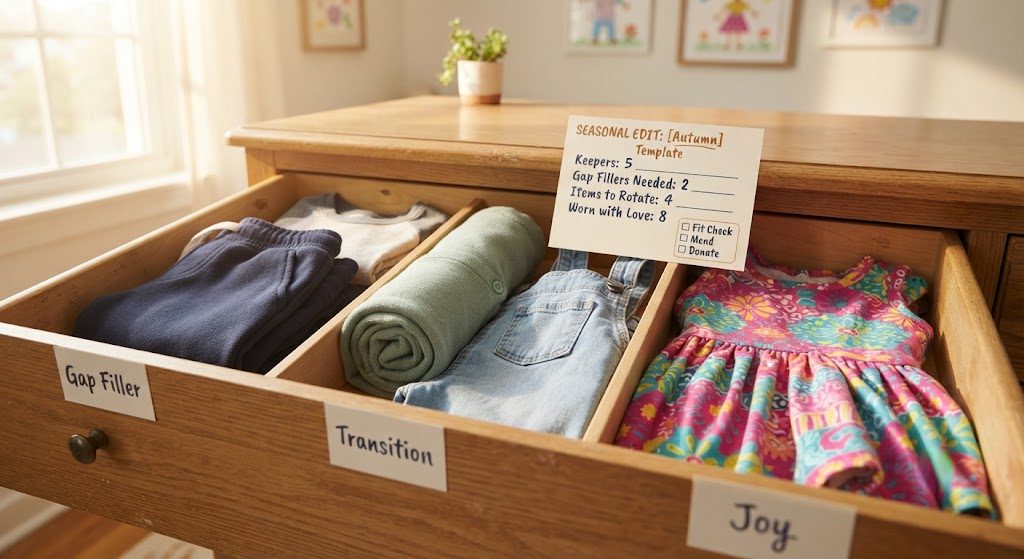
This is the practical replacement. A pair of reinforced-knee joggers to replace the ones that wore through. A long-sleeve tee in a new neutral to replace the one that stained beyond recovery. The gap filler is not exciting, but it's the backbone of a capsule wardrobe. I buy the best quality version I can afford for this category because it will get worn hardest.
The Transition Piece
This is the piece that bridges seasons. A lightweight cardigan that layers over short-sleeve tees in early spring and over long sleeves in late fall. A pair of shorts in a heavier cotton that works for both warm autumn days and early spring playgrounds. Transition pieces extend the life of everything else in the drawer because they make warm-weather clothes wearable longer and cool-weather clothes wearable sooner.
The Joy Piece
This is the one I added after watching Ella fall in love with a twirly dress and wear it until the hem frayed. The joy piece is not frivolous — it's the item that gets worn with delight, and that delight translates into more wears per season. For Jack, it was a t-shirt with a dinosaur print that he insisted on wearing every laundry cycle. For Maya, it's a pair of soft shorts in her favorite color. One joy piece per season, chosen with intention, does more for a child's relationship with their wardrobe than a drawer full of "sensible" basics.
The Seasonal Edit Template
Over the years, I developed a simple template that takes thirty minutes per child, twice a year. I pull everything out of the drawer. I try on anything I'm unsure about — especially pants and anything with sleeves. I identify three items to rotate out and write down why. I list the three items I need: one gap filler, one transition piece, one joy piece. Then I shop only from that list. No clearance racks, no "just browsing." The list is permission to ignore everything else.
The result is a wardrobe that stays manageable, fits the child who's actually standing in front of me, and costs roughly a third of what I used to spend on seasonal refreshes. More importantly, it removes the frantic, guilt-laced scramble to "get ready for the season." My kids don't need a new wardrobe every three months. They need a small set of clothes that fits their bodies, their lives, and their own emerging tastes. Three pieces, twice a year, is enough.



Travellers Write
No letters yet — be the first traveller to write.