The Silk Dress That Wasn't Silk
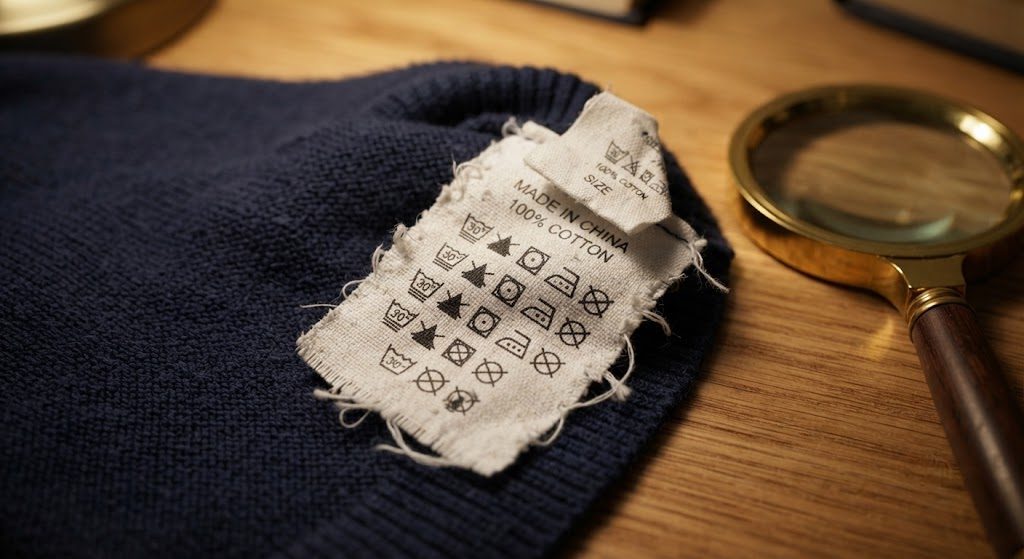
When Ella was 4, my mother gifted her a beautiful "silk" dress. The fabric was smooth, the sheen was lovely, and the price tag suggested quality. I hand-washed it in cold water exactly once, and the dress came out stiff, scratchy, and two inches shorter. Only then did I squint at the care tag: "100% rayon." The silk was a lie my fingers believed, and the tag had been telling the truth the whole time in tiny, folded print. That afternoon, I sat down with every garment in my kids' drawers and taught myself to read care tags like they were legal documents. What I found changed how I shop, wash, and decide what's worth keeping.
The Three Lines That Matter Most
Every care tag has up to five sections, but three of them do the heavy lifting. If you read nothing else, read these.
Fiber Content
This line lists what the garment is made of, in descending order by percentage. "100% cotton" sounds simple, but the type of cotton is missing. As I learned from my pilling deep dive, long-staple cotton behaves differently from short-staple, and no care tag tells you which one you are holding. However, some clues exist: if the fiber is named with a trademark — "TENCEL Lyocell," "SUPIMA Cotton," "CORDURA Nylon" — that usually indicates a higher-grade, licensed fiber. If it just says "cotton" or "polyester" with no qualifier, assume commodity-grade. For blends, the ratio matters. A 60% cotton, 40% polyester sweatshirt will pill less than a 100% cotton one of the same weight because the synthetic fibers anchor the short cotton ones. But it will also breathe less. There is always a trade-off.
Country of Origin
"Made in China," "Made in India," "Made in Portugal" — these are not just geography. Certain regions specialize in certain fabrics. Portugal has a long tradition of high-quality knitwear. Japan is known for precise stitching and selvedge denim. India produces some of the best organic long-staple cotton but also some of the worst fast-fashion knits. The country alone does not guarantee quality, but paired with the fiber content, it gives you a baseline expectation. I have consistently found that Portuguese-made cotton knits for kids outlast similarly priced counterparts from other regions in my wash log, and I now deliberately seek them out at consignment sales.
Washing and Drying Symbols
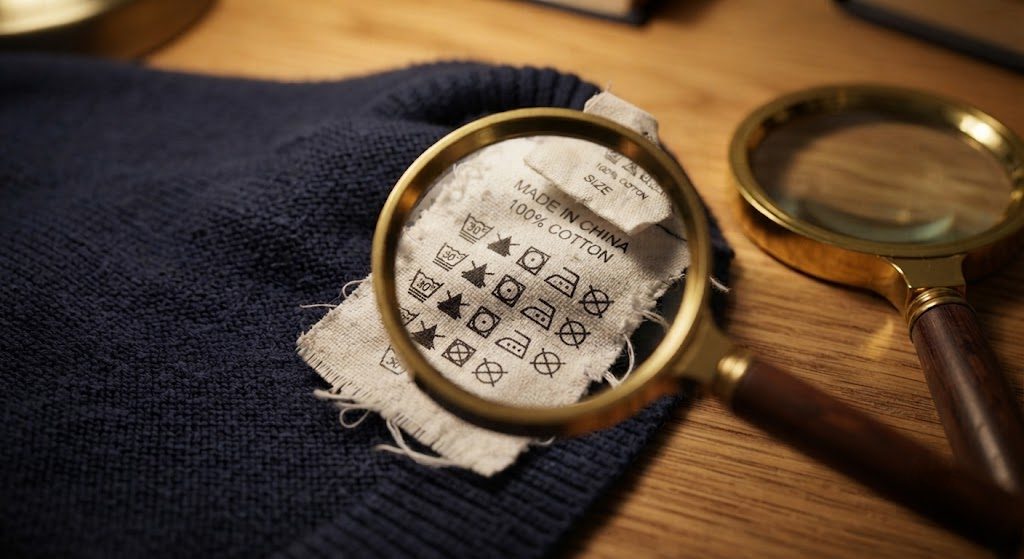
The hieroglyphics of the care tag — the little bucket, the triangle, the circle in a square — are standardized by the FTC in the US, but many brands still get them wrong or leave off critical information. The bucket tells you the maximum water temperature. One dot means cold, two mean warm, three mean hot. The circle in a square is the dryer; dots inside indicate heat level. A big X through the dryer symbol means hang dry, and ignoring it is the number one reason clothes exit my fail bin before ten washes. I set a hard rule after shrinking three wool-blend sweaters: if the tag says "do not tumble dry," I either air dry or I do not buy the garment for daily kids' wear. The triangle is bleach; a solid triangle means any bleach, a triangle with diagonal lines means non-chlorine bleach only. For kids' clothes, I ignore bleach entirely and use oxygen-based stain removers, which are gentler on fibers.
What the Tag Does Not Say (But Should)
Some of the most useful information about a garment's durability is not legally required and therefore absent. The tag will not tell you the staple length of the cotton fibers, the twist level of the yarn, the type of dye used, or whether the seams are flat-locked or overlocked. These are the factors that determine whether a onesie makes it through one child or three. The tag also won't tell you if the fabric was preshrunk — if it was not, expect significant shrinkage in the first wash regardless of your water temperature. I have learned to test for shrinkage by measuring a garment's length and width before washing, then comparing after the first cold cycle. Any garment that loses more than 5% in length goes back if I am within the return window.
Another invisible detail: colorfastness. A care tag will never say, "This red dye will bleed onto everything you own." But you can test it at home. I soak a cotton swab in warm water and rub it firmly on an inside seam. If color transfers to the swab, that garment gets washed alone for the first five cycles. This test has saved me from pink underwear disasters with Jack's dark wash jeans and kept Maya's white bodysuits actually white.
Julia's Care Tag Checklist
After documenting 1,800-plus garments, I now run a 10-second assessment before buying anything for my kids. First, I check the fiber content for specific branded fibers or suspiciously vague terms. Second, I find the country of origin and mentally cross-reference with my wash log's best-performing regions. Third, I look at the dryer symbol — if it is an X, I calculate whether I am willing to air dry this item for the next six months. Fourth, I stretch the garment gently along the seams and watch how the stitches move; the care tag cannot show this, but a garment that puckers at the seam under light tension will unravel there first. Finally, I ask myself: if this tag is hiding something, what is it probably hiding? Usually, the answer is shrinkage, pilling, or color bleeding — all manageable if I know in advance, and all infuriating if I don't.
Travellers Write
No letters yet — be the first traveller to write.