The Midnight Sheet Change
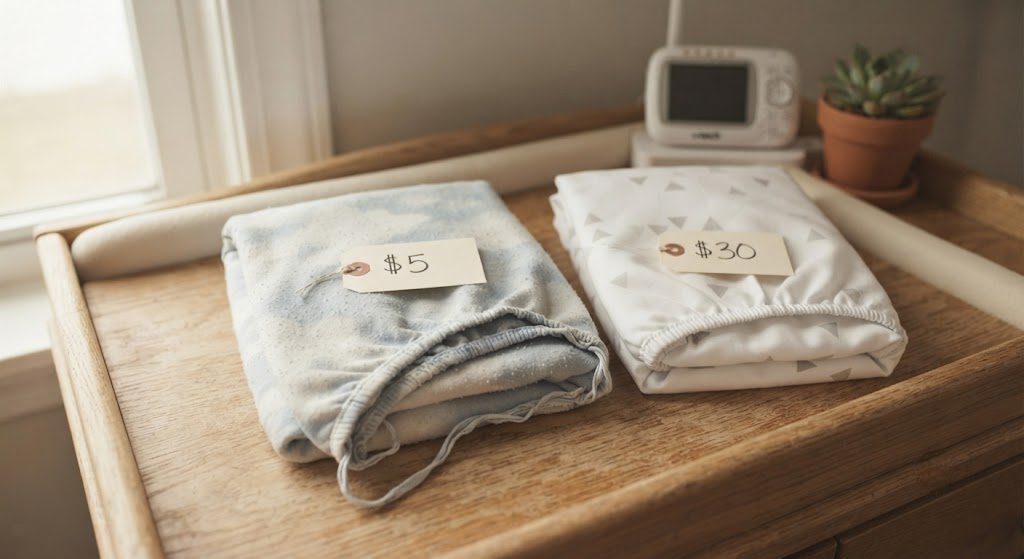
At 2 a.m. on a wet November night, Maya woke up crying. I stumbled into the nursery and found her crib sheet had popped off the corner of the mattress for the third time that week. The elastic was limp, the fabric had pilled into tiny rough bumps against her cheek, and I was standing barefoot in the dark, furious at a piece of cotton. That sheet had cost $5. The next morning, I ordered a $30 organic cotton sheet out of spite and started a six-month test to find out whether the price difference was real or just marketing.
The Two Contenders
I chose two crib sheets at opposite ends of the price spectrum. The $5 sheet was a standard cotton-polyester blend from a big-box store, 200 thread count, elastic all around. The $30 sheet was GOTS-certified organic cotton, 300 thread count, with reinforced elastic and a label promising it would fit mattresses up to 6 inches deep. Both were washed together, dried together, and rotated on Maya's crib every week for six months. I logged every wash, every corner pop-off, every texture change.
What Actually Differed
Shrinkage
The $5 sheet shrank 4 inches in length after the first three washes, which is why the corners kept popping off. It wasn't the elastic's fault — the sheet itself had become too small for the mattress. The $30 sheet, which was preshrunk, lost less than half an inch. If a crib sheet doesn't say "preshrunk" on the packaging, it will not fit by month two. This is the single biggest difference I found.
Elastic Quality
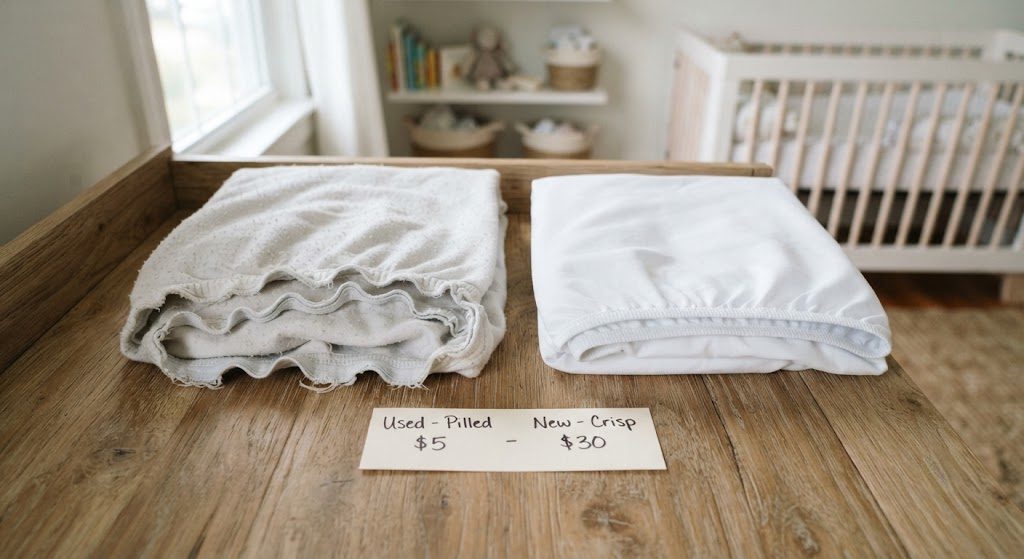
Both sheets used full-perimeter elastic, but the $5 version was a thin, single-strand elastic that stretched out permanently. By month three, I could pull it a full extra inch with no resistance. The $30 sheet used a wider, flat elastic encased in a double-fold hem that maintained tension for the full six months. However, the $30 elastic eventually relaxed slightly too — just much later and less dramatically. No elastic lasts forever under toddler gymnastics.
Pilling and Texture
The $5 polyester-blend sheet developed surface pills by week four. The $30 organic cotton sheet did not pill at all but developed a slightly rough texture after about 20 washes, which is normal for uncoated cotton. Interestingly, Maya showed no preference between them. She slept the same on both. The texture issue bothered me more than it bothered her.
What Didn't Differ
Breathability
I expected the polyester blend to sleep hot, but Maya never sweated through either sheet. Both regulated temperature adequately for a Portland nursery that stays between 60 and 70 degrees. In hotter climates, the cotton-only sheet would likely have an edge.
Fit, Eventually
Once the $5 sheet shrank past the point of secure fit, the comparison ended. But for the first month, both fit the mattress equally well. If you buy a budget sheet and replace it every two months, it technically works. That math, however, is worse than buying one durable sheet.
The Verdict: One Durable Sheet Beats Three Cheap Ones
At the end of six months, the $5 sheet was in the rag bin. The $30 sheet is still on Maya's mattress, slightly worn but fully functional. If I averaged the cost per usable week, the cheap sheet cost about $0.63 per week. The expensive sheet, now entering month seven, costs $0.22 per week and falling. The real budget move is to buy two good sheets — one on the mattress, one in the wash — and stop replacing cheap ones every season. I only wish I had learned this before buying seven bad sheets across my first two kids.

Travellers Write
No letters yet — be the first traveller to write.